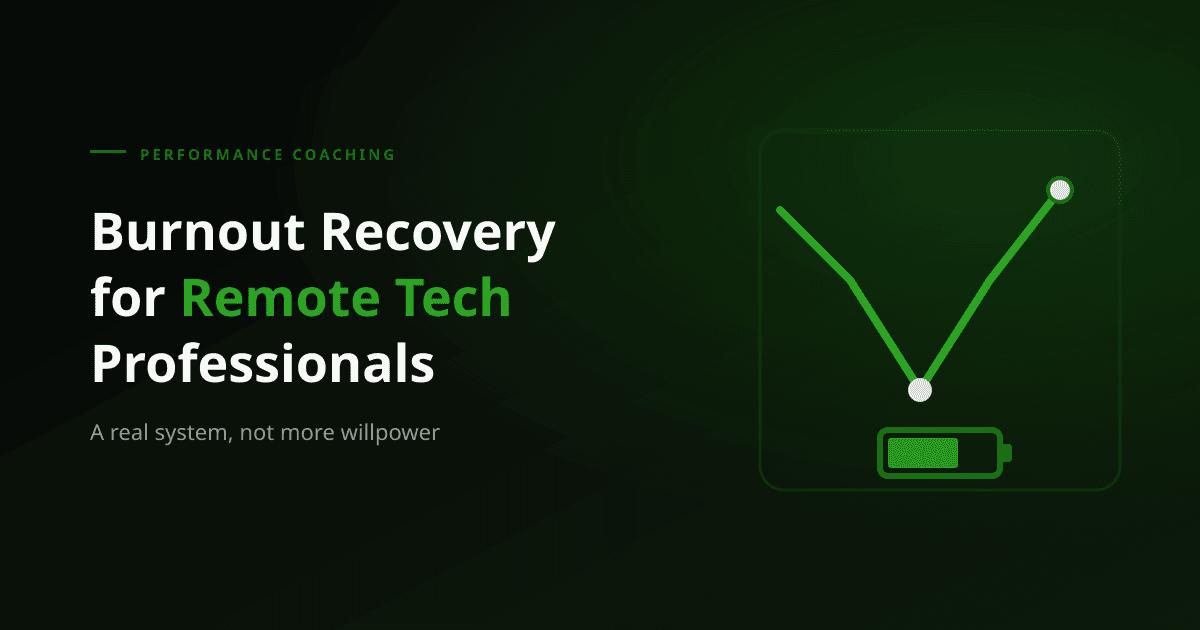
Remote tech burnout is quiet, not dramatic. Here's why willpower alone won't fix it, and what a real recovery system looks like.
Burnout in tech doesn't usually announce itself. It shows up as a slow leak — you're still hitting deadlines, still showing up to standups, but the work that used to feel engaging now feels like wading through wet sand. If that sounds familiar, you're dealing with something a weekend off won't fix, and you're far from the only one.
Remote and hybrid tech roles created a specific kind of burnout that's different from the classic "overworked in an office" version. Here's what it actually looks like, why willpower alone doesn't solve it, and what a real recovery path involves.
Why remote tech burnout looks different
Gallup's 2023 State of the Global Workplace report found that 44% of employees worldwide report experiencing a lot of daily stress — and remote/hybrid tech roles carry a specific version of it, without the visible edges an office job has. For a related pattern in a different setting, see how the same brain-based coaching approach applies to building resilience in kids facing their own high-pressure moments.
Office burnout usually has visible edges — long hours everyone can see, an obvious crunch period, a clear before-and-after. Remote burnout is quieter. The workday has no natural boundary anymore. Slack notifications arrive at dinner. "Just five more minutes" turns into an hour because there's no commute forcing a hard stop. And because nobody's watching you physically struggle, it's easy to convince yourself you're fine right up until you're not.
The result is a specific pattern: performance holds up on paper for a long time, while focus, patience, and motivation quietly erode underneath it. By the time it's visible to a manager, it's usually been building for months.
The system problem, not the willpower problem
Most burned-out professionals don't need more discipline. They've usually got plenty — that's often how they got so deep into overwork in the first place. What's missing is a system: a repeatable way to protect focus, set real limits, and recover energy on a schedule instead of only when things fall apart.
This is where brain-based coaching methods differ from generic productivity advice. Instead of another to-do list app, the work starts with understanding how your specific brain responds to stress, what actually restores your focus versus what just feels like rest (doomscrolling is not rest), and building habits around that — not around a template that worked for someone else.
What a reset actually involves
The 30-Day Reset Program exists specifically for this stage — four structured sessions over a month, built for people who are stuck, stressed, or quietly burned out and need a real starting point rather than another article to read later. The four sessions typically move through:
- Naming exactly what's draining energy versus what's just uncomfortable — the two get confused constantly
- Building one or two non-negotiable boundaries around work hours and communication
- Rebuilding a focus habit that actually fits a remote schedule, instead of copying an in-office routine that never applied
- Locking in a system that holds up after the program ends, not just during it
For professionals who want to go further — a career pivot, a promotion push, or a full reset of how they work — the longer Transformation Program extends this into eight sessions, with more room to work through bigger structural changes.
What actually changes in four weeks
Clients rarely report feeling "less tired" as the main outcome — that's a byproduct. What changes first is a returning sense of control: knowing when the workday actually ends, catching the early signs of overload before they become a bad week, and having an actual plan instead of just gritting through it.
If you're not sure where you'd even start
A single Strategy Session is the lowest-commitment way to find out whether this kind of coaching would help — no program, no long-term commitment, just a real conversation about what's going on and whether a structured reset makes sense for you. All of this is available virtually, wherever you're working from, so location is never the barrier.
Burnout that's been building for months doesn't reverse in a weekend. It does reverse with a real system and someone who's helped other high-performers build one.